How should I live

I believe I have found who I am. I enjoy the pleasures of Music, of Books, of thoughts inside my head about life and the human condition. 

I equally take pride in my ability to think rationally through problems, in the clear and complete manner of a mathematician. 

And that's who I am: 

An artist of thought, whether that be words or music, lucidly and embracingly of aware our conditions are humans, whether that be reflective, introspective, or extrospective, grounded in morality. 

And driven by love constrained by limited time, by a startling poignant view of the nature of life and find every bit of it worth living, that I respect and light an internal engine of life, to make me tackle world-changing challenges, that being in science, in engineering, in business, in initiatives with palpable potential to change the way we live. 

Now from the pragmatist in me, I shall push forward the world by day, and unravel life as a human at night. 


CPenguin. 


Regret for Knowledge

For at least once, we had all wished to turn back time; to redo a blunder, to save ourselves an embarrassment, to save a loved one. We wanted to make our futures better by changing the past.

I, rather, want a different future, a future that merges both my current and my dreams future. My regret lies in my incompetence to follow my own plans. If I did follow what I set out to do, no matter the result, I'll be satisfied, for I have truly given it my best. As it turns out, my worst enemy is myself. 

Optimism

"Be Optimistic" is the worst motto ever. It hides the truth in a deceptive sheath. It values belief over action.

I've heard an old adage, that when sailing, "The pessimist complains about the wind; the optimist expects it to change; the realist adjusts the sails".

In the previous quote, I considered pessimists to be inferior to optimists, since optimists, albeit effectively doing nothing, has a good spirit.

Yet, recent events have shown light on the dark underbelly of my own optimism, revealing a sour truth: 
When it comes to knowledge, 
The Realistic scholar knows what they know
The Pessimistic scholar doesn't know that they know
The Optimistic scholar doesn't know that they don't know

Thus, Optimists are masters of self-deception. 
And that frightens me greatly. 

Nostalgia

Nostalgia disperses like a droplet of watercolor, seeping effortlessly into the canvas of rumination. It colors your memories with hues of time, overlaying scenes from a long-lost past with shades of sepia and dusk-like gold.

It happened instantly. One night, as my family gathered for dinner, my father decided to sell my childhood home. Properties, like ruins, are places where memories gather like dust. Within seconds, memories from years ago were fetched, propelling me back into moments of joy and sadness. I saw my childhood neighbors, some of which my best friends, and the times we had together, waltzing amidst an air of pure joy and freedom. Memories like those I couldn't let go.


These treasured recollections lie unsullied in a mythical niche, providing transient escapes from the calamities of existence. Yet, when presented with the future, we often fall back into the comfort of the past—a quagmire that maroon your spirit within tides of faded glory. Perhaps it's humanity's great frailty—we prefer past happiness to future uncertainty.

As if orchestrated to the pitch of my grief, an onslaught of fear swept through, a fear that all too soon the time will come when I must bid farewell, to an era of innocence in which I no longer existed. It bitters to gaze upon events that cannot be changed—an embitterment that besmears, at the heart of my childhood carefree jubilation, a stain of regret darkened by a perpetual sense of loss.

But those drunk on lost glory become mindless fools; Only by releasing phantoms of memories they hold so dearly could they step boldly back into reality and find salvation. If faltered, they fade into their past, adrift at the mercy of history's restless tides.

So here, I raise my glass, to my past for its occurrence, to memories from whose fount I drink to rejuvenate, to outbreaks of sentiment that tether my humanity, and to bid farewell to oceans of antiquated history in pursuit of new memories dawning at horizon's brink.

Time Fleets

When Einstein described his Theory of Special Relativity, he claimed that "time is merely a stubborn illusion." While that statement explains the time-independence nature of absolute speed (namely the speed of light), it could also be interpreted in a literal manner.

Einstein wanted a simple, everyday scenario to serve as an analogy to his claim regarding time. He came up with this comparison: if you were to sit in a boring lecture, straining to stay awake, then every minute could feel like an hour; yet if you were to sit across from a gorgeous man or women, each hour would feel like minutes. 

Now, that analogy works to a certain extent, but I could extend that to another scenario. Weekends. Weekends are illusions of free time, time without liability; and without responsibilities, I lack the incentive to roll out of bed or, if by some miracle I do, be productive. In no time, Friday has gone by; Saturday has gone by; and Sunday night rolls around. At about 9pm Sunday night, I muster up the courage to glance at the clock, not the hour but the date on the clock. It reminds me of deadlines and of consequences. 

I've heard that no matter how high or how drunk, if you hear the word "cops", you receive an instant burst of adrenaline that snaps you out of trance. The word "Sunday" displayed in bright white LED lights snaps me out of my two-day somnambulism, catapulting me back to a world where responsibility exists. 

Time fleets. Friday, Saturday, and Sunday might seem like a boatload of time, until that boat sinks under the weight of reality. Yet, despite realizations every Sunday night and despite self-promises to manage time better, I still find myself stuck in the quagmire of procrastination. Energy just doesn't seem to come to me, no matter how fervently I call upon it. I sink deeper and deeper, every week, as residual tasks I put off pile into mountains of debt. 

I gave it some thought. It could be me, but it could also be the environment I submerge myself in. Maybe next year, when people I surround myself are those of high-productivity, I could be rejuvenated by the collective aura of energy, impelling me to become a productive version of myself, which in turn radiates energy in a positive feedback loop. 

Or perhaps that's just another excuse I make for my own indolence.


Discontinuities and Incongruences: Part 2

While I was sipping coffee and reading a Washington Post article about Trump's plans to reinstitute a new "NAFTA", an idea intruded my sea of thoughts.

What is Percentage?

Imagine a situation where you're watching a drag race, a blue car against a red one. Suppose the blue car is traveling at a speed 25% faster than that of the red car. Then, is the red car 25% slower?

Nope. It's only 20% slower. Why is there a 5% difference? Because of the very definition of ratios. That definition itself defies common sense.

_________________________________________________________________________________
Math Digression:

From a mathematical standpoint, denoting the percentage that the faster car is traveling at as (%faster), which in this case is 25%, then using simple arithmetics, we can deduce that the difference between the two values, which in this case is 5%, will always follow this equation:


This equation implies that the disparity between the percentage in two phrases grows exponentially at first but dwindles out into a linear incrementation as numbers grow larger.
_________________________________________________________________________________


I've always viewed math as an expression of intuitive logic, but this simple thought changed that perception. It could either be that math could never perfectly translate human logic or that math, being built on basic logic, transcends our current understanding and explores logical truth beyond our intuition.

After wrestling with my own mind for a while, I stored this conundrum in a virtual filing cabinet and went back to my coffee and news article. Perhaps the next time I wait in line for an amusement park ride, I'll take it out and mull it over some more.


What is color?


I love meeting people and getting to know the lives of the others. In fact, that's the very mission of my blog. Sometimes, however, I prefer solitude. It is only by myself could I contemplate questions beyond without the distraction of society.

Today, as I had my second cup of coffee and as I read my second article in the Economist (which talked about the failing economy of Turkey), my thoughts were diverted onto an experiment I read earlier.

It was a famous psychological experiment involving people born blind at birth. That particular experiment revealed that the participant's dreams were actually pitch black as they had never encountered color.

However, what really struck me was the researcher’s interpretation of what the blind subjects saw during dreams—“Black” they called it. If blind subjects have no methods of identifying color subjectively, is it truly right for us to classify what they saw as "black"? This also triggers an interesting thought experiment. Hypothetically, if a person saw blue as green and vice versa from the first day, then when we point to blue, they would see green (according to our spectrum) but recognize it as "blue". 

In fact, chances show that you might be the one with this symptom and there is currently no way to prove or disprove that claim. Say for example, that someone went to school, looked a blue color card, saw green, but because the card was labeled with the word "blue", they learned it as such. The next time they see something blue, though they are actually seeing green, but because they learned that their "green" translates into English as "blue", they say "blue", making us assume that they have perfect color discretion, while their brain stimulants are actually different from ours when we see the same color. 

"Black” is the color our scientists claim the subjects saw, but the blind observer does not know what black is or is able to distinguish it from any other color as they were never exposed to color. 

This brings up two questions. One, could we classify the color the participants' see "black" if they do not consciously recognize it as such. Two, is color subjective?

Sure, we have a way of classifying color by wavelength. Just get a spectrometer or wavemeter and measure the wavelength of the incident light. That would very objectively identify the so-called color of certain light. But, what about wavelengths outside of our visible spectrum? Some animals could see into the infrared or into the ultraviolet. Unfortunately, we can't. As such, can we still assign a color to those lights we cannot perceive? Even for electromagnetic waves (light) of frequencies we could see, who's to say that a certain wavelength is a certain color. Isn't every interpretation correct since the very nomenclature of the classification of light by color is, fundamentally arbitrary?


Are we alone in the universe?

Since I was a child, I have looked up at the night sky and wondered: Is there anyone out there? Are we unique?

The cornerstone of Christianity is the notion that we are the center of the universe, that God created this world to be the center of all worlds. When Ptolemy published his geocentric model of the universe, the church jumped at the idea of a scientific theory to back up their "fantastical" sayings. He proposed that the stars in the universe traveled in concentric circles—with Earth in the middle—and that the universe was bounded by a background strip riddled with stars. 
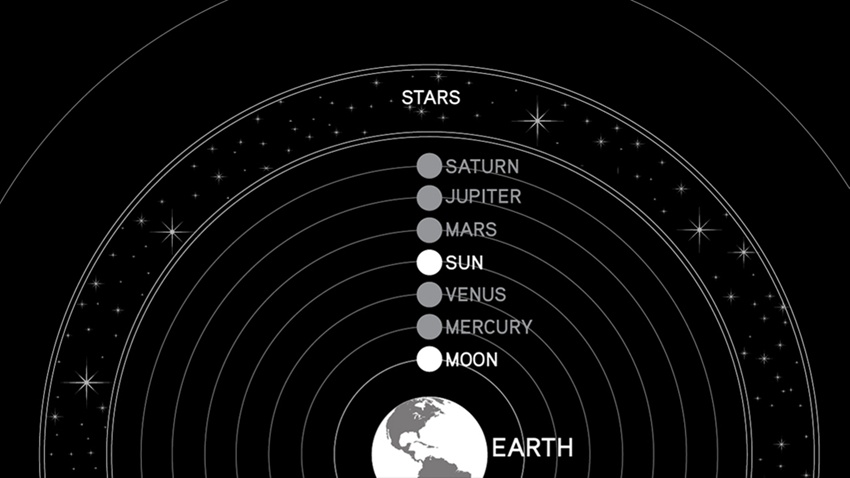
Image result for ptolemy model of universe
Modern depiction of Ptolemy's model

However, Ptolemy's geocentric model came with an inherent anomaly, the fact that some stars deviated from their predicted routes and made twirls in the sky. Nowadays, we understand that those stars are planets near us, and the swirls they make are just byproducts of relativist motion to the rotation of the and surrounding planets. Back then, to explain this bizarre phenomenon, Ptolemy introduced the idea of epicycles, that stars sometimes just makes spirals within their paths. 

For a while, observations confirmed his theory. 


Until one day, Copernicus came along and used a different model to explain retrograde motions explained by epicycles. By observing the path of the Sun in the sky, he manifested the heliocentric model, where the Earth and other nearby planets orbited the Sun. This way, he was able to take the ungrounded idea of epicycles out of the equation and still accurately match theory with observation. 

It was not until Galileo that provided the first piece of evidence to truly support Copernicus's theory. After investigating the use of optics to magnify light, Galileo made his own telescope, powerful enough to discern the four largest moons of Jupiter (Lo, Europa, Ganymede, Callisto), which we now call the Galilean Moons. He found empirical evidence that those moons orbited around Jupiter and not around the Earth, disproving the Geocentric theory. Although his discovery was considered heresy, forcing him to recant his teachings, the Heliocentric model began gaining massive support. 

Later on, the work of Newton, describing the laws of universal gravitation, and Kepler, who deduced the equations that govern planetary motion, that led to the confirmation of the Heliocentric model we know and learn today. 


I always thought I loved physics because of the outlandish ideas proposed in the study of quantum mechanics. In retrospect, the moment I gazed up at the night sky might be the moment I fell in love with physics. 

It's amazing to think that, hundreds of years ago in ancient Greek, someone just like me looked up at the night sky and noticed that the scattered speckles of light seemed to move ever so slightly. So he/she named them "planētēs", Greek for "wanderer". 


I easily step onto extended digressions. It might just be the way my brain synthesizes information. Anyways, back to the main query at hand: are we alone?


There are arguments for both sides, but personally, I prefer to think that there must be some lifeform out there, maybe more or maybe less evolved, wondering the same question as they stare bewildered at the starry night. One scientist says it all in one quote, "The universe would be a waste if we were the only ones to enjoy it."

The origin of the universe itself is trippy, to say the least. After the initial implosion of the big bang, particles and antiparticles cancel out in mutual annihilation, releasing massive amounts of energy that are still detectable today in the form of cosmic microwave background radiation. It is by pure chance that there was one additional particle out of every billion particle-antiparticle pairs. That odd one out per billion is that makes up all the mass in the universe today. 

And that all happened in the first millionth of a second since the birth of the universe. 


And are we unique? Well, we've been dying to find out since September 1977, when NASA send footage of Earth on a probe out into space, hoping that one day an extraterrestrial with enough intelligence would be able to decrypt the code (which was transcoded in a hydrogen-based code, very clever) and return a message. 


According to statistical models, there is a high probability that there is some form of extraterrestrial life out there. Then, where are they and why haven't they contacted us yet? Human civilization has only been around for 300,000 years, but the milky way has existed for millions. Shouldn't some alien civilization have already developed interstellar travel, or at least, communication? This is the basis for the Fermi paradox, which finds the lack of evidence paradoxical to the high probability of extraterrestrials. 

But for the sake of argument, let's assume for a second that we are alone. Why then, are we alone? 

The best hypothesis is a theory known as the Great Filter. The concept is that there is some catastrophe, something so great that all previous civilizations on any stars were unable to survive. This could have been the reason for the absence of other lifeforms. This could also mean that our civilization is about to face that very filter, something we couldn't dodge. This is what scientists today are worried about. Maybe it's an irreversible global warming that destroys our planets and, consequently, us. It is a dark road to go down. 

There is also another possibility that the Great Filter is behind us, that the asteroid that destroyed the dinosaurs (which lived for millions of years) was the filter. Life, somehow, managed to squeeze through the cracks and burst out living again. This is an optimistic view and hopefully, this has happened. 

This could only be resolved if we knew if other civilizations exist out there. 

We have sent out electromagnetic waves in all frequencies in attempts to contact potential lifeforms out there.  Maybe one day we'll hear back from them. Maybe we already have; we just didn't decode it yet. But I'm always hopeful, hopeful that someone or something will respond, hopeful that it will happen during my transient lifetime. 

As the night grows darker, the stars, again, appear against a solid black backdrop. After so many years, I'm still fascinated by the galaxy. Every night, I'll be stargazing, and, like my 8-year-old self, I'll continue to wonder what could possibly be out there. 


Discontinuities and Incongruences: Part 1

Have you ever wondered: What is language?

I once thought that language was based on commonly agreed-upon nomenclatures and syntaxes.
For instance, no means no.


But recently I've come across this conversation

Friend, "I stayed at home last night."
Me, "So you didn't attend the reunion?"
Friend, "Nope."

Sounds normal. But is it?

In this scenario, instead of "Nope", my friend should have answered "Yes."
Because what he really meant was: "Yes, I didn't attend the reunion."

Yet if someone actually said, "Yes." in that situation, it would have been unconventional. i.e.

Me, "So you didn't attend the reunion?"
Friend, "Yes."


So what happened there? Does our intuition correct for common grammatical errors by logical inference? How did this flaw originate?


This is just one of many anomalies in this world.

My Unresolved Question

Any photo we are to take today is limited in clarity by the pixel count of that photo.

That is to say, a very far object might only appear as one pixel on the picture, rendering it unable to be identified.

But, if we were to take that same photo from the same location but with a strong enough telescope, then the object would be covered by more pixels, increasing its resolution and allowing us to identify what it is.

Then, assuming that there are no obstacles obstructing light, if we had a sufficiently strong telescope, we could clearly resolve an object of any distance when observing from a stationary reference point.

Yet, the distance between the object and our stationary point of observation grows exponentially in while our eye at the telescope remains a fixed cross-sectional area, resulting in a more "pixel dense" image as we increase the strength of our telescope.

This gives rise to the question: Is it possible to resolve an object infinitely far while keeping a set cross sectionary area and stationary point of observation?

In other words, how "pixel dense" is light? How much information could light carry?

Understanding the Exposure Triangle (with f-stop proof)

The exposure triangle is basically three factors that affect exposure: ISO, shutter speed, aperture.

1. ISO
This value is calculated in lumens/area, controlled by the microprocessor that determines how much analog data would be collected by each photosite which corresponds to effective pixel (because some border pixels are used to determine parameters, not for actually capturing the image). 

The ISO is also split into native ISO and extended ISO. The native ISO is how light each photosite could actually hold before it spills. For example, if the native ISO goes from 100 to 4000, then each photosite could hold a maximum of 4000 lumens/area. The extended ISO goes much higher into values like 12000, or 208500 lumens/area. This would introduce a great deal of gain because the extended ISO isn't the photosite absorbing more light information, but a manipulation does by the software. I personally never go up that high and I do not recommend it as it would mess up the image. 

Finally, if you were to double the ISO, you would get double the exposure. Also, exposure is counted in "stops", one additional stop of exposure is equivalent to doubling the exposure. 

2. Shutter Speed
The time duration of exposure of each photosite. If your shutter speed was set at 1/100th of a second, then each photosite would be exposed to light for 1/100th of a second. Usually, the time would be a fraction of a second. Sometimes, for long exposure effects like making waterfalls look silky, you might have a shutter speed that's longer than a second. 

On a mechanical shutter, the effect of rolling shutters would occur if the speed isn't fast enough. It's where an object moved while the shutter was scanning from top to bottom. Also, since the shutter scans from top to bottom but the image that comes through the lens is upside down, the lower part of the image is actually older than the top part. However, in a video camera, pixels are read from bottom to top to counteract the effect of the vertical flip from the mirror. So in those cases, the top part of the image is actually older than the bottom part. 

If you were to double the shutter speed, say from 1/100th to 1/50th of a second, then you would get one more stop of exposure. 

3. Aperture
This is the extremely tricky one. Aperture is measured in f-numbers or f-stops (which is not the same as a stop of exposure, though both do have the word "stop" in them).

If you have an aperture of f4, then to get one more stop of exposure, you would adjust it to f2.8. I know, it's very confusing. Why does the numerical value go down to get more exposure? Why isn't it f5.6 (which is a multiple of 2 of 2.8)? Well, when you do a google search on the internet, they would give you this following chart to reference.


This chart shows two things, the f-stops that you need to get to double exposures and that the smaller f-stops are actually bigger apertures. 

What most people couldn't to explain is why. 

The equation for f-stop (f) is actually this: 

f = L/D

where f is the f-stop, L is the focal length, and D is the diameter of the aperture.

The focal length is the distance from the focus center of the lens to the focal plane (image sensor), but for now, ignore it; it doesn't affect exposure, and for our purposes, it's constant.

The first equation is the definition of f-stop. All remaining steps use F to represent f-stop.

How to calculate f-stop in relation to exposure

Basically, the idea is that double the area of the aperture, double the exposure. Now, we need to convert that idea into a number for the f-stop.

Thus, the multiple of the f-stop is the inverse square root of the multiple of exposure.

I actually made a calculation error in the example. bf on the last line should be f2.
If I started off shooting at f4, then I would get f2.8 in order to double the exposure.


Anyways, for those starting off with photography or just wanting to understand how exactly f-stops correlated with exposure, I hoped this helped.